Hey, all.
I'm working on a theory that the modern Christian theology of "marriage unification” (based on Gen 2:24) is flawed, and there is a more accurate way of interpreting what the text says of it.
For example, the marriage union is often spoken of (these days) in terms of "the equal joining of a man and woman"- almost like the "yin" and "yang" coming together through the union of marriage- equal yet opposite natures creating a whole, complete circle. I think there is strong biblical evidence that indicates that this is not the way that God intends us to view the marriage union.
It has to be stated off-the-bat that this is in no way to belittle or devalue women- it's simply an exploration of the structures that God sets in place for the benefit of his people. There's a ton of scripture on how to lovingly cherish your wife/women, but that's just not the focus of this thread.
Ok, so, here we go: "Therefore a man shall leave his father and his mother and hold fast to his wife, and they shall become one flesh." In Genesis 2:24, we clearly see that a man and woman unify by marrying/becoming one flesh. This verse by itself does not provide much more context to the issue, but to keep things in perspective check out 1st Corinthians 11: ... since [man] is the image and glory of God, but woman is the glory of man. For man was not made from woman, but woman from man. Neither was man created for woman, but woman for man.
Pretty interesting. We see:
The greater context of this passage is dealing with some key Christian thought on headship structure, but I want to focus on the line: This mystery is profound, and I am saying that it refers to Christ and the church.
The implications being:
If this cosmic symbolic analogy does indeed go both ways (which is highly likely based on many other scriptures), then we can actually extrapolate meaning both ways, and especially for our purposes, the nature of the unification:
Does the "equal joining" (like the "yin" and "yang" analogy) apply to Christ and the church? Are we like "two halves coming together to make a whole"? Absolutely not! Christ is the head of the church, and we unify to him by submitting to him. Sooooo..... Does this not also apply to marriage? According to the interpretation of the text that I am proposing, it absolutely does apply. I contend that men and women are not proportionately unified in marriage- or at least that our modern "two halves becoming whole" mindset is way off.
Just as the church unifies with Christ in submission TO him, in marriage, the WOMAN joins TO the man by submission to him. Not to be crass, but a microcosm of this essentially the moment of marital consummation: the man pursues the woman, and the woman submits her body to him, (thus becoming his wife, following the "doctrine of sex is marriage" that we see played out throughout the bible). If either party improperly upholds their roles (aka if the man forces himself on her, or the woman refuses to submit herself), the result is terrible, but if the man pursues/loves/cherishes his woman and she submits her body openly to his pursuit, the result is .
.
Anyway, I think this has major implications for how we view not only Biblical headship, but even more importantly, Godly marriage: and of course, for the purposes of this forum, marriage structure. The "equal joining" of a man and a woman, the way that the modern-day Church seems to view marriage, is likely the result of 2,000 years of monogamy-only philosophy. The ancient Christian context, however, does not support this view, but rather the “disproportionate unification” of a wife to her husband.
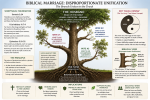
To understand this better, we can look at the headship analogy that I posted a couple of weeks ago that you can read about here: https://www.biblicalfamilies.org/forum/threads/biblical-headship-healthy-trees.18147/. Based on the post, we can build on the analogy of biblical headship as being like an anatomically healthy "excurrent" tree. The analogy holds that the man, as the head of the family, is the dominant stem, AKA "trunk", of the tree, and his wife/wives are the branches. The branch is joined TO the tree, yet they both are intrinsically unified at the point where their forms have become one, and through the clear submission of the branch to the trunk (if you read the post, it is clear that, with trees, if a branch tries to become a "co-dominant stem", significant structural issues arise).
With the image of the tree in mind, rather than two halves of a circle coming together (as implied by modern Christian marriage theology), woman is joined TO the man, just as the branch is joined TO the trunk. Again, this in no way is meant to diminish wives and Womanhood, this is just gaining understanding of the structures God puts in place for the benefit of his people.
Of course, this has major implications for plural marriage vs. monogamy-only. If a man and his wife are two equal sides of the same circle (i.e. "yin" and "yang"), or something like that, it is not feasible for that circle to join with another half circle. This is why the thought of plural marriage seems incompatible in the minds of most modern Christians.
However, with "disproportionate unification theory", it makes perfect sense. If a man's role in his family is as the dominant stem/trunk of the tree, he is of course able to be unified with more than one branch by unifying them (separately) to himself.
I bring all this up because I believe a lot of the cognitive dissonance surrounding plural marriage for modern Christianity can be explained by understanding and accepting this deeply biblical principle.
Okay, thoughts, questions, comments are all welcome!! Tell me what you think.
I'm working on a theory that the modern Christian theology of "marriage unification” (based on Gen 2:24) is flawed, and there is a more accurate way of interpreting what the text says of it.
For example, the marriage union is often spoken of (these days) in terms of "the equal joining of a man and woman"- almost like the "yin" and "yang" coming together through the union of marriage- equal yet opposite natures creating a whole, complete circle. I think there is strong biblical evidence that indicates that this is not the way that God intends us to view the marriage union.
It has to be stated off-the-bat that this is in no way to belittle or devalue women- it's simply an exploration of the structures that God sets in place for the benefit of his people. There's a ton of scripture on how to lovingly cherish your wife/women, but that's just not the focus of this thread.
Ok, so, here we go: "Therefore a man shall leave his father and his mother and hold fast to his wife, and they shall become one flesh." In Genesis 2:24, we clearly see that a man and woman unify by marrying/becoming one flesh. This verse by itself does not provide much more context to the issue, but to keep things in perspective check out 1st Corinthians 11: ... since [man] is the image and glory of God, but woman is the glory of man. For man was not made from woman, but woman from man. Neither was man created for woman, but woman for man.
Pretty interesting. We see:
- Man being the image and glory of God, and woman being the image and Glory of man.
- Man not coming from woman, but woman coming from man.
- Man not being created for woman, but woman for man.
The greater context of this passage is dealing with some key Christian thought on headship structure, but I want to focus on the line: This mystery is profound, and I am saying that it refers to Christ and the church.
The implications being:
- The union between a man and his wife is a picture of the union of Christ and the church.
- The union between Christ and the church is a picture of the union of a man and his wife.
If this cosmic symbolic analogy does indeed go both ways (which is highly likely based on many other scriptures), then we can actually extrapolate meaning both ways, and especially for our purposes, the nature of the unification:
Does the "equal joining" (like the "yin" and "yang" analogy) apply to Christ and the church? Are we like "two halves coming together to make a whole"? Absolutely not! Christ is the head of the church, and we unify to him by submitting to him. Sooooo..... Does this not also apply to marriage? According to the interpretation of the text that I am proposing, it absolutely does apply. I contend that men and women are not proportionately unified in marriage- or at least that our modern "two halves becoming whole" mindset is way off.
Just as the church unifies with Christ in submission TO him, in marriage, the WOMAN joins TO the man by submission to him. Not to be crass, but a microcosm of this essentially the moment of marital consummation: the man pursues the woman, and the woman submits her body to him, (thus becoming his wife, following the "doctrine of sex is marriage" that we see played out throughout the bible). If either party improperly upholds their roles (aka if the man forces himself on her, or the woman refuses to submit herself), the result is terrible, but if the man pursues/loves/cherishes his woman and she submits her body openly to his pursuit, the result is
.Anyway, I think this has major implications for how we view not only Biblical headship, but even more importantly, Godly marriage: and of course, for the purposes of this forum, marriage structure. The "equal joining" of a man and a woman, the way that the modern-day Church seems to view marriage, is likely the result of 2,000 years of monogamy-only philosophy. The ancient Christian context, however, does not support this view, but rather the “disproportionate unification” of a wife to her husband.
To understand this better, we can look at the headship analogy that I posted a couple of weeks ago that you can read about here: https://www.biblicalfamilies.org/forum/threads/biblical-headship-healthy-trees.18147/. Based on the post, we can build on the analogy of biblical headship as being like an anatomically healthy "excurrent" tree. The analogy holds that the man, as the head of the family, is the dominant stem, AKA "trunk", of the tree, and his wife/wives are the branches. The branch is joined TO the tree, yet they both are intrinsically unified at the point where their forms have become one, and through the clear submission of the branch to the trunk (if you read the post, it is clear that, with trees, if a branch tries to become a "co-dominant stem", significant structural issues arise).
With the image of the tree in mind, rather than two halves of a circle coming together (as implied by modern Christian marriage theology), woman is joined TO the man, just as the branch is joined TO the trunk. Again, this in no way is meant to diminish wives and Womanhood, this is just gaining understanding of the structures God puts in place for the benefit of his people.
Of course, this has major implications for plural marriage vs. monogamy-only. If a man and his wife are two equal sides of the same circle (i.e. "yin" and "yang"), or something like that, it is not feasible for that circle to join with another half circle. This is why the thought of plural marriage seems incompatible in the minds of most modern Christians.
However, with "disproportionate unification theory", it makes perfect sense. If a man's role in his family is as the dominant stem/trunk of the tree, he is of course able to be unified with more than one branch by unifying them (separately) to himself.
I bring all this up because I believe a lot of the cognitive dissonance surrounding plural marriage for modern Christianity can be explained by understanding and accepting this deeply biblical principle.
Okay, thoughts, questions, comments are all welcome!! Tell me what you think.
Last edited: